
The Early Modern Center
Department of English, UCSB
Welcome to the EMC Homepage
to bottom
EMC
Ballad Project
Themes
Events
Faculty
Grads
Undergrads
Courses
Login
Gallery
Slideshows
Bookshelf
EEBO
ECCO
Links
Hours
Room Schedule
About Us
English Department

In Memoriam

Richard Helgerson, 1940-2008
"Now cracks a noble heart."

            Richard Helgerson, one of the leading scholars of Renaissance literature, died in Santa Barbara, California, on April 26 after a long battle with pancreatic cancer.  Helgerson, who was known, among other things for his studies of the ways in which the earliest European nation states described themselves to themselves and to the world, was a professor of English at the University of California, Santa Barbara, an institution at which he had taught since 1970. A memorial service will be held at the UCSB Faculty Club from 4:00-6:00 p.m. on Friday, May 23.
            Helgerson was the author of six important books, including an edition and translation of the French Renaissance poet Joachim Du Bellay, and more than sixty articles and reviews.  His most influential publications were Self-Crowned Laureates, a major study defining the distinctively Renaissance career patterns of three major English writers, Edmund Spenser, Ben Jonson, and John Milton, and Forms of Nationhood: The Elizabethan Writing of England on the early discourse of nationhood.  Published in 1993, Forms of Nationhood won multiple scholarly awards, including the British Council Prize for the best book in any area of British studies and the Modern Language Association James Russell Lowell prize for the best book in any area of literary studies.  This book in particular established Helgerson’s international reputation as one of the leading Renaissance scholars of his generation. 
            Helgerson was the recipient of many grants including a Guggenheim Fellowship, a National Endowment for the Humanities Fellowship, a University of  California President’s Fellowship, and awards from the Folger and Huntington Libraries.  In 1998 he was chosen Faculty Research Lecturer at UCSB, the highest scholarly honor the campus can bestow, and in 2005 he received the Lifetime Achievement Award from the International Spenser Society.  Helgerson was chair of the UCSB English Department from 1989 to 1993 and also served in other important administrative and consultative roles in the university and the scholarly profession at large.  He was particularly noted as a mentor to graduate students and his former doctoral students are now established scholars at colleges and universities all over the United States.
            Diagnosed with pancreatic cancer in 2005, Helgerson immediately launched a new scholarly project, a wide-ranging discussion of the classical, imperial, and personal themes of the “new poetry” of the late sixteenth century in Spain, France, and England, as refracted through a single early Spanish sonnet.  Completed within a year, A Sonnet From Carthage was published by the University of Pennsylvania Press in 2007 and has been hailed by, among others, David Quint of Yale University as “beautiful,” an “elegantly crafted scholarly and critical essay.”
            Helgerson was born August 22, 1940, in Pasadena, California, where he attended school.  He graduated from the University of California, Riverside, in 1963 with a B.A. in English.  From 1964 to 1966 he served in the Peace Corps in Atakpamé, Togo.  He received his Ph.D. from The Johns Hopkins University in 1970, after which he joined the faculty at UCSB as an assistant professor, advancing through the ranks to full professor in 1982. 
            Helgerson is survived by his wife of more than 40 years, Marie-Christine Helgerson, who is well-known in France as the author of novels for children; by their daughter, Jessica Helgerson, a “green” interior designer based in Portland, Oregon, and her husband Yianni Doulis, an architect;  by two grandchildren, Max and Penelope; and by his sister Jan Ondeck, of Walnut Creek, California.
            Tributes to Richard Helgerson have poured in over the two and a half years since his diagnosis.  Below are some reflections by a few of his colleagues at UCSB among the many who held him dear to their hearts:

Mark Rose:  “He was one of the most distinguished scholars ever to have taught in the humanities at UCSB and his influence has been felt wherever the literature and culture of the European Renaissance is studied.  He was also one of the most generous and committed teachers of graduate students that I have ever seen.”

Patricia Fumerton:  “His academic and personal life were at all times marked by exemplary acuity, curiosity, dedication, leadership, humility, generosity, and grace.  He was a laureate critic and a laureate human being.  The praise once directed to William Shakespeare could as equally be spoken of Richard Helgerson: ‘He was not of an age but for all time.’”

Michael O’Connell:  “As a scholar, colleague, mentor, and friend, Richard was the soul of generosity.  In the more than 37 years I knew him, he never failed his colleagues and students with the help they needed, the right advice at the right time, the shrewd critique, the penetrating question.  His own extraordinary scholarship was characterized by a deep humanity, asking questions that mattered and answering them in ways that made Renaissance texts as vivid and lively as our own world.”

Alan Liu:  I recently dedicated a book to Richard, and I can't say it any better than I said it there: 'I do not know of a more consummate citizen and leader of our profession: at once disciplined and open, rigorous and generous, pragmatic and idealistic, careful and caring, great and good.'  Richard cared deeply about his students, his department, the university, scholarship, and general society and culture--all at the same time.  Those were all one mix for him.  I don't know how those of us in the English Department who are in younger generations can live up to his measure, especially without the advice and mentorship that he always so generously gave.

A fund in honor of Richard—the Richard Helgerson Graduate Achievement Award—has already been established.  Donations should be made out to “The UCSB Foundation" and indicated "for the English Dept. Richard Helgerson Achievement Award fund"; they can be sent to Joni Schwartz, Department of English, University of California – Santa Barbara, Santa Barbara, CA 93106-3170.

For those who would like to share their memories of Richard, a weblog has been set up.

Professor Harry Berger, Jr. also offers a more extended reflection upon Richard Helgerson's laureate career in an essay titled "An Intellectual Appreciation."


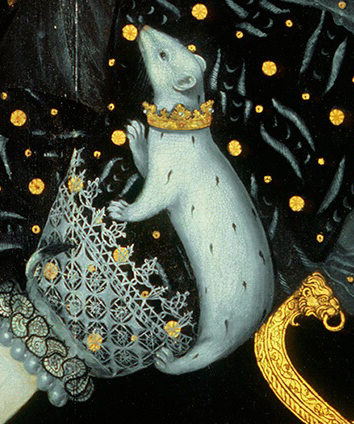
Girl Aged 4   —Oliver, Isaac 
T

he Early Modern Center at UCSB mobilizes the English department's strength in sixteenth- through eighteenth-century studies, which is maintained by eleven faculty in the field. The Center provides a specially-constructed space (consisting of a seminar area, resource library, and networked computers) that promotes collaborative research and teaching. State-of-the-art computing equipment is supported by the latest databases in the field, including the Early English Books Online (EEBO), consisting of all extant books published in England from 1475-1700, and the Eighteenth Century Collections Online (ECCO), 1701-1800. The Center creates courses around innovative annual themes; supervises the department's undergraduate specialization in Early Modern Studies; organizes colloquia and conferences; produces an online gallery of images and archive of internet resources; maintains a bookshelf of rare books in its library and critical reviews on its website; and offers a graduate student assistantship each year.

The EMC is proud to announce that it has won a National Endowment for the Humanities Reference Materials Grant of $325,000 to complete its online Pepys Ballad Archive during 2006-2008. Congratulations ballad team! For the award proposal, see the NEH Reference Materials Grant Proposal.


2007-2008 Annual Theme:
Science and Technology

The 2007-2008 EMC Theme, "Science & Technology," will provide a forum to explore these two terms as interrelated and mutually constitutive fields of inquiry in the early modern period. We conceive of science and technology as a broad range of social and cultural practices, cultural and historical formations, and epistemological perspectives. Fields of study that might fall under such a broad definition of science and technology include: horticulture, botany, engineering, automata, stage machinery, navigation, cartography, anatomy, medicine, alchemy, the occult, taxonomy, archiving, printing, and information science. Across these and other fields, we want to ask questions such as: How and why were systems of knowledge created and proliferated? What particular scientific developments participated in the exploration of the body, the mind, time, and space? How were individuals, communities, and nations impacted by new systems of knowledge, particular objects or hardware, or advanced procedures to accomplish tasks?

Each year the Early Modern Center and its affiliates organize a number of exciting courses and events around the yearly theme. Several early modern graduate and undergraduate courses will be in dialogue with the year’s theme. The EMC will host a Winter conference on "Science & Technology, 1500-1800" as well a Spring undergraduate conference showcasing students’ work from participating courses throughout the year.

Other than in previous years, this year's Fall Colloquium will be on a theme separate from the annual theme, and will instead commemorate the 200th anniversary of the abolition of the British slave trade.


EMC Gallery

The Early Modern Center Gallery is a featured resource of the center, containing reproductions of many important period images in thumbnail, browser, and large high-quality sizes. A random image from the Gallery is sampled below.

Course of Empire: The Savage State.  Cole, Thomas,  1834. Oil on canvas100 x 160 cmRectangularNew York Historical Society
The Early Modern Center
University of California at Santa Barbara, Department of English, South Hall 2510
Director: Patricia Fumerton ~ Graduate Fellow: Sören Hammerschmidt
to top